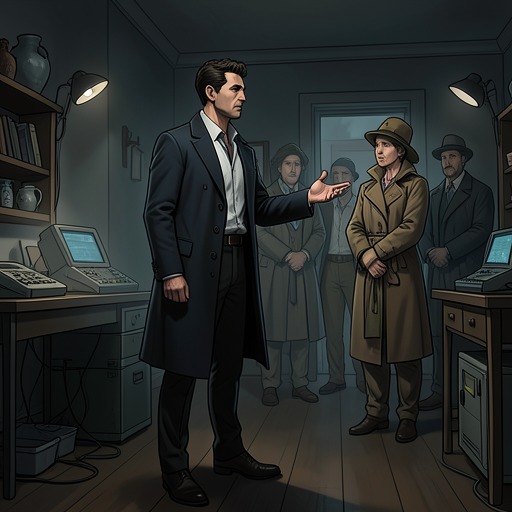
Albertine fails to keep their appointment
In Search of Lost TimeAlbertine’s failure to keep an appointment exposes how quickly the narrator’s longing becomes jealousy, and how little he can know of the life she leads beyond his sight. A message sent through the lift-boy, a night of waiting, and Albertine’s explanation the next day do not resolve uncertainty; they make absence itself the occasion for love.
The Message and the Missed Meeting
The narrator instructs the lift-boy to bring Albertine Simonet back with him from Epreville, where she is staying. He insists that the boy tell her the message is from him and says she will be delighted to come, then immediately admits to himself that this assumption is not at all natural. He adds that reaching him from Berneville is inconvenient, but orders the boy to bring her anyway. His confidence is thus partly an effort to encourage the messenger and partly a way of protecting his own self-esteem.
The lift-boy first returns with Albertine, explaining that he has gone by bicycle and that neither the porter nor the head doorman knew where he had been. On another occasion, however, he reports that he could not find her and could not wait longer. His anxious smile and the phrase “You know I couldn’t find her” are not signs of amusement or confidence: the narrator recognizes that the boy uses the familiar address to soften the news and spare himself the strain of delivering it. The narrator’s attention to the boy’s embarrassment gives this small failure a human counterpoint; he concludes that people who snigger when caught at fault are often afraid of displeasing others, and should be met with pity rather than anger.
The lift-boy eventually says that Albertine is not at Epreville and will not return before nine. If she happens to come back earlier, he promises, the message will be given to her; in any case, he expects her to reach the narrator before one in the morning. But on the night in question, after the boy has failed to find her, Albertine does not appear. The promised meeting is displaced first into a chain of uncertain timings and then into an absence that the narrator must interpret for himself.
Waiting and the Change in Feeling
The narrator’s account gives the missed visit a larger emotional significance. A person’s charms, he observes, may be less likely to cause love than the knowledge that the person is unavailable that evening. Among friends, the news might barely register; only later, when the mind is alone with it, does its emotional force become clear. A previously tolerable life can suddenly seem changed, not necessarily because the lover fears death, but because the prospect of separation has become difficult to contemplate.
At first, the narrator waits beyond the one o’clock limit the lift-boy had set. By three, however, the certainty that Albertine will not come brings relief rather than renewed anguish. He recasts the night as one of many ordinary nights when he does not see her, and imagines that he may see her the next day or on some later day. That accepted blank becomes comforting. The shift is not evidence that his attachment has ended; it shows how the mind can ease distress by changing the expectation against which the absence is measured.
The narrator also questions the apparent cause of his suffering. He compares the anxious waiting to the effect of a drug: the sufferer mistakes the source of a painful condition and believes he is distressed about the woman who is absent, when the discomfort itself may be what generates the feeling called love. Such an explanation cannot simply correct love, he adds, because love remains mistaken whatever its cause. The missed appointment therefore becomes more than a disappointment: it demonstrates how feeling can be produced and intensified by a misreading of one’s own symptoms.
Albertine’s Letter and the Limits of Knowledge
The next day, Albertine writes that she has only just returned to Epreville and did not receive the narrator’s note in time. She asks whether she may come to see him that evening. Instead of treating this explanation as a settled account, the narrator imagines that behind her letter’s words—as behind what she once said on the telephone—there may have been pleasures and people she preferred to him. Her communication provides information about the missed message, but does not supply the knowledge he desires about how she spent her time.
That thought stirs a painful longing to know what Albertine has been doing. The narrator describes love as something latent that is always carried within; for a moment he nearly believes this renewed pain will bind him to her. But the feeling shudders in place and fades without fully developing. The episode thus ends not in a clear answer about Albertine’s conduct, but in the narrator’s recognition that suspicion can awaken love without giving it a secure object or a reliable basis.
A Pattern of Suspicion
The narrator connects this episode with his earlier failure to understand Albertine during his first visit to Balbec. He had taken her refusals to stay with the group or abandon such plans as a garden-party, a donkey-ride, or a picnic as simple frivolity. During his second visit, he begins to suspect that this appearance of light-mindedness may conceal, or even be invented to conceal, other purposes. That suspicion is explicitly limited: he sees events from his side of a glass that is not transparent and has no means of determining what reality lies on the other side.
The missed appointment supplies a model for that uncertainty. A delayed message, Albertine’s absence, and her subsequent explanation can be arranged into a story of preference and concealment, but the narrator cannot verify that story. What the event establishes most securely is not a secret in Albertine’s life, but the narrator’s dependence on conjecture when her movements escape his view. Absence becomes evidence in his mind precisely because it leaves the facts unresolved.